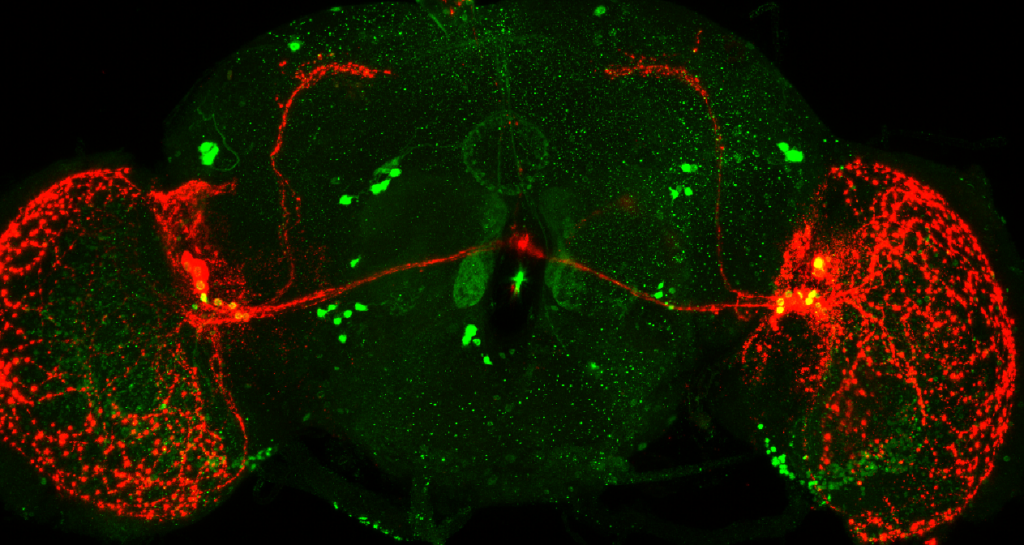
I work in a neuroscience research lab, and it has been a challenge for me to describe exactly “what it is that I do” to others. I’ve realized that translating scientific concepts (and “jargon”) into layman’s terms is its own skill that needs to be trained. Even the best scientists can find it difficult to answer basic questions in a satisfying way.

In this video, Richard Feynman is asked why magnets repel each other (and why they attract when one of them is turned around). Feynman won the Nobel Prize for his work in Quantum Electrodynamics, and was well known as an effective science communicator, but he chooses to take this opportunity to explain how “why” questions can be so difficult to answer.
There are multiple “layers” for why things happen, and in normal conversation we can take most of them for granted because we share common experiences. But as you continue to ask why, you get to deeper (and more interesting) explanations that go beyond our common reference points and become difficult to explain in words. Feynman gives an example of someone recovering in the hospital:
“Aunt Minnie is in the hospital.”
– Why?
“Because she slipped on the ice and broke her hip.”
(Most people would be satisfied with this answer and stop)
– But some may ask: Why is ice so slippery?
“Because water expands when it becomes solid ice. So when you put pressure on ice, a small amount of it melts and returns to liquid form. Most other substances contract when becoming solid and remain solid when pressure is applied.”
– Why does water expand when it becomes solid?
…and so on. Feynman eventually does give an answer to how magnets work, and explains it is a similar mechanism to the electrical forces that prevent your hand from going through solid objects (like a chair). But he says he cannot give a full and accurate explanation using only terms the audience is familiar with – and if he tried, he would be “cheating” the audience with misleading analogies.
I hope to use this section of the blog to help me more effectively communicate what we are studying in the laboratory, as well as the tools and techniques most useful to us. I’ll have to start with notes on various projects and principles (Level 1 posts ), then I will try to tie things together and move through increasing layers of complexity (Level 2 and 3 posts).
Data from current or unpublished experiments are omitted.
Posts in this Category
- Journal Club³
- Background³
- Mini-white marker
- Alzheimer’s
- Cryptochrome¹
- Biochemistry¹
- Central Dogma¹
- ENCODE Project¹
- Luminometer¹
- PCR¹
- Tetrodotoxin¹
- Confocal Microscopy¹
- Immunohistochemistry¹
- Mutagenesis¹
- 2017 Nobel Prize¹
- Drosophila Basics¹
- Techniques³

One response to “Science”
-
Test comment from free account on mobile.
Leave a Reply