Introduction
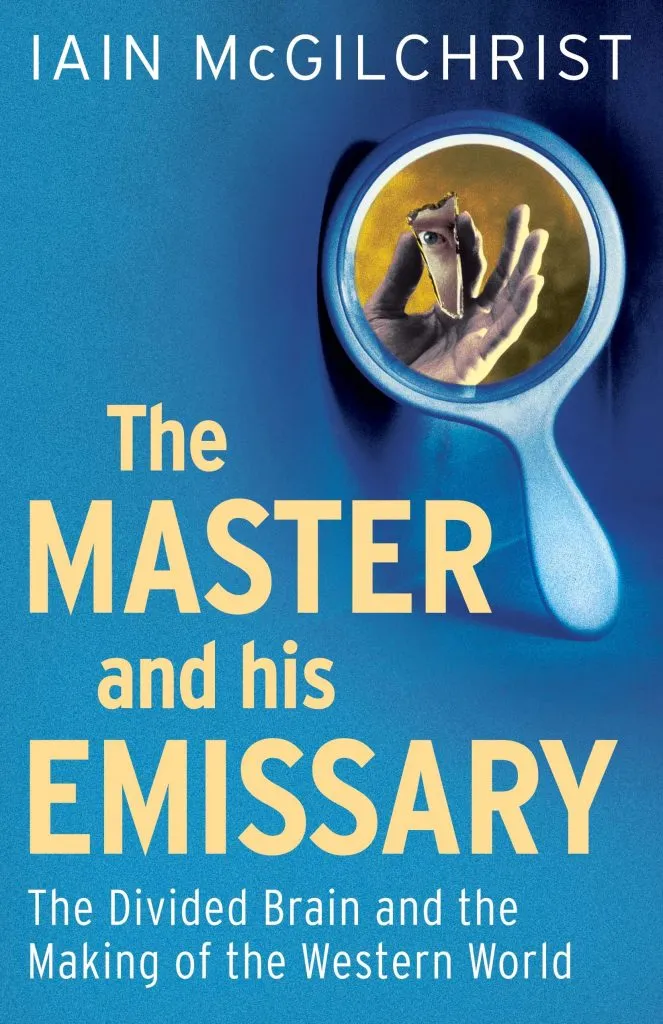
McGilchrist introduces the metaphor from a Nietzsche parable: the right hemisphere as the “Master” (broad, holistic, contextual view of the world) and the left as the “Emissary” (narrow, analytical, utilitarian). The emissary is valuable but can betray the master by usurping power, leading to a fragmented worldview. This sets up the book’s thesis on hemispheric imbalance shaping culture.
There was once a wise and benevolent spiritual master who ruled a small but prosperous domain. He was known for his selfless devotion, temperance, and wisdom, which brought peace and flourishing to his people.
As the domain grew larger and more populous, the master realized he could no longer oversee everything personally. Certain matters required delegation to maintain his broad overview and holistic care for the realm. He therefore trained and appointed trusted emissaries—clever and capable assistants—to act on his behalf in distant parts of the land.
The brightest and most ambitious of these emissaries proved exceptionally useful, handling details and practical tasks efficiently. However, this emissary was not wise enough to recognize his own limitations; he suffered from “ignorance of his ignorance.”
Over time, the emissary began to view the master’s humility, patience, and restraint not as strengths, but as weaknesses. He grew contemptuous, believing himself to be the true source of the realm’s success: “I’m the one who does the real work here; I’m the one who really knows.”
Gradually, the emissary usurped power. He adopted the master’s mantle, pretended to be the master, duped the people, and turned the domain into a tyranny focused on control, efficiency, and self-interest.
In the end, the realm declined into ruin, destroying both the true master and the usurping emissary.
Moral/Warning: The emissary is indispensable as a servant but disastrous as a ruler. When the detailed, analytical tool (emissary) betrays and overthrows the holistic, contextual wisdom (master), society loses its grounding in meaning, empathy, and interconnectedness, leading to alienation and collapse.
This fable illustrates McGilchrist’s thesis on brain hemispheres: the right hemisphere as the “master” (broad, intuitive, embodied) and the left as the “emissary” (narrow, logical, manipulative)—with modern Western culture reflecting the dangers of the emissary’s dominance.
Part One: The Divided Brain
Chapter 1: Asymmetry and the Brain
Explores the evolutionary and structural asymmetries between the hemispheres, drawing on neuroscience to show they are not symmetrical mirrors but have distinct architectures and functions from early development.
Chapter 2: What Do the Two Hemispheres ‘Do’?
Reviews neurological evidence (e.g., split-brain studies, stroke patients) showing consistent differences: the right hemisphere handles broad attention, context, and living things; the left focuses on details, tools, abstraction, and manipulation.
Chapter 3: Language, Truth and Music
Examines how language is primarily left-hemisphere (denotative, literal), while music, metaphor, and implicit meaning are right-hemisphere. Discusses how hemispheres approach truth differently—left as explicit and certain, right as embodied and nuanced.
Chapter 4: The Nature of the Two Worlds
Describes the distinct “worlds” each hemisphere creates: right sees interconnected, alive, ambiguous reality; left sees abstracted, mechanistic, categorized parts. They yield incompatible but complementary experiences.
Chapter 5: The Primacy of the Right Hemisphere
Argues the right hemisphere should lead for a coherent, grounded view of reality, integrating context and wholeness; the left excels at details but distorts when dominant.
Chapter 6: The Triumph of the Left Hemisphere
Explains why the left often overrides the right (e.g., denial of broader context in pathology), warning of risks when the emissary dominates without the master’s oversight.
Part Two: How the Brain Shaped Our World
Chapter 7: Imitation and the Evolution of Culture
Links hemispheric differences to cultural evolution, emphasizing imitation (right-hemisphere driven) as key to social learning, while left-hemisphere tools and abstraction drive innovation but risk detachment.
Chapter 8: The Ancient World
Traces early cultures (e.g., Greek) showing initial right-hemisphere balance (holistic myths), shifting toward left-hemisphere reasoning (e.g., Plato), leading to fragmentation.
Chapter 9: The Renaissance and the Reformation
Views the Renaissance as a right-hemisphere revival (embodied art, wonder), but the Reformation as left-hemisphere dominance (literalism, iconoclasm, rejection of metaphor).
Chapter 10: The Enlightenment
Describes peak left-hemisphere influence: faith in reason, mechanism, abstraction (e.g., Descartes, Newton), yielding progress but reducing life to machine-like parts.
Chapter 11: Romanticism and the Industrial Revolution
Romanticism as a counter-movement reasserting right-hemisphere values (emotion, nature, intuition); Industrial Revolution as left-hemisphere triumph (efficiency, exploitation).
Chapter 12: The Modern and Post-Modern Worlds
Analyzes modernity/post-modernity as extreme left-hemisphere dominance: bureaucracy, virtualization, irony, loss of meaning—creating a self-referential, fragmented hall of mirrors.
Conclusion: The Master Betrayed
Reflects on the contemporary world as fulfilling the parable’s warning: left-hemisphere usurpation leads to alienation, environmental crisis, and diminished humanity. Calls for rebalancing toward the right hemisphere’s holistic view.

Leave a Reply