There aren’t many modern songs (of any genre) that have had long-term appeal for me. It may seem like much more of a niche, but videogame Original Sound Tracks (OST) have stuck with me far longer than anything coming from the traditional music industry.
When no one else is around (like during my morning/evening commute) I am very frequently whistling one of the tunes I’ve featured in this post. Some of it is certainly nostalgia, but many of the tracks I’ll feature in the post actually come from games I’ve never played.
In addition to providing playable links so you can listen to the music on this page, I’ll include some information about each game as well. Hopefully that can provide some context to what each selection means to me.
From “Most Played” Games:
It ought to come as no surprise that the songs I listen to the most have come from the games I’m most familiar with.
… but do I appreciate these soundtracks because I enjoyed the games, or was I drawn to these games (at least in part) because they had such wonderful music?
I put this at the top of the list for a couple of reasons… If you only click on one soundtrack in this post, it should be this one. Just about every track composed for this game is incredibly beautiful (I’ve selected 10 in the linked playlist, but there are many more). Skyrim is one of the most popular games ever made – and has been repeatedly republished across several platforms spanning well over a decade now. No doubt a large portion of its success is due to the “atmosphere” the music helps create.
I haven’t played this game nearly as much as the others – I think I’ve only played through to the end of the game once. But the soundtrack is definitely the most played for me. I actually know the composer’s name (Jeremy Soule), and the music gives such a welcoming feeling of being home.
Pokémon is the biggest (highest lifetime earning) franchise in the world, even surpassing Disney and the Mickey Mouse brand. Growing up in the 1990s, Pokémon was a fixture of my childhood. I have several fond memories of playing with friends over physical “link cables” and later over the internet.
On its face, Pokémon is a very simple game: collect and train various elemental creatures to eventually become the champion. Hundreds of options enable near endless replay value. Under the surface, there is enough complexity in abilities, “shiny” hunting, and even Pokémon breeding to keep players engaged after completing the story.
The tracks I selected for this playlist span several “generations” of Pokémon games. Battle themes are popular among fans, and there are some of those included, but I’ve mostly highlighted the calm and relaxed music I think more accurately captures my experience with these games.
- National Park (Gen 2 remaster) – A very relaxing track, this stands out as among the most memorable for me across all Pokémon games. It seems amazing this was composed for a videogame. I’ll certainly accept nostalgia bias on this, though.
- Route 10 (Gen 5) – Another very “chill” soundtrack. I had mostly stopped playing by this point, but the generation 5 games are considered by many to have the best overall soundtrack.
- Area Zero, Battle (Gen 9) – I haven’t played the newer games, but I still found this remix of a battle theme using 8-bit “sound font” from the oldest generation. It is very fun to whistle the melody.
- Hoenn ending (Gen 3) – Hoenn is the name of the region in the 3rd generation (Kanto and Johto for 1st and 2nd). This song plays after the climax of the game, and I think it does a really great job of communicating the end of a long journey.
- Relic Forest (Gen 3*) – This serene tune is my chosen representative from the GameCube spin-off games. “Colosseum” and “Gale of Darkness” each have several tracks I like. These games feature corrupted “shadow” Pokémon, and Relic Forest is where they can be purified of corruption.
- Route 113 (Gen 3) – The 3rd generation is my favorite, so here’s another from that series. This route is characterized by having continuing ash softly falling like snow at the base of a volcano. I just think it is really fun to whistle this one.
- Champion Blue, Battle (Gen 1 remaster) – Your rival’s canonical name in the first Pokémon games is “Blue.” He is always one step ahead of you throughout the game, but it still comes as a surprise plot-twist to see him that last time. You’ve just defeated Lance, the dragon master, and leader of the “Elite Four.” You would’ve been the champion, but Blue beat Lance just before you did, so there’s a satisfying final showdown between you and your spoiled brat (professor’s grandson) of a rival.
The Old Republic
This is the game I played throughout college. Reportedly costing over $300 million, this was the most expensive game to produce at time of release (a few games have since surpassed it). The plot is set roughly 4,000 years before the events in the movies. This was Star Wars before Disney purchased the rights to the franchise.
I might actually like the Old Republic era Star Wars more than the original trilogy. The characters are great (Revan, Mandalore, HK-47) and it added some philosophical backbone to the Light/Dark sides of the force (Jedi and Sith “codes”).
SW:TOR is the only MMO game I’ve played. That genre of games can be very time consuming (and addicting for some) – it is highly social. I became very good at this game, was part of a few “server firsts,” and by the time I stopped playing I was ranked at the top of all Gunslingers (1 of 8 playable classes) in North and South America.
- Alderaan, the Throne – This theme is from the planet destroyed by the Death Star in the first movie (Episode IV). It is a beautiful, nature-filled world controlled by rival royal families. The soundtrack nicely reflects their romantic and sophisticated society at the beginning, but transitions to a much more tragic tone to point toward the planet’s future destruction.
- Manaan (Ahto City) – This theme from an almost entirely water covered world has a such a simple composition, but remains as probably the most relaxing tune I know of.
- Coruscant, the Capital – The capital planet of the Republic and later Empire. I really love the use of French Horn and string instruments in this soundtrack.
- Balmorra, the Forge – An industrial, factory dominated world. This song makes the list for both the first and last minute of the track, both of which use vocals purely as a musical instrument (there are no actual lyrics).

Hearthstone is the main game I played in graduate school. It’s an online collectable card game based on the characters from “World of Warcraft” (the most famous MMO game). Heavily leaning into the fantasy genre, it focused on simplifying mechanics and emphasizing a more whimsical personality to be more approachable than the popular physical card game “Magic: The Gathering.”
In addition to the very relaxing soundtrack, spells have fun animations and every card you play onto the board has a voice line or sound effect (SFX database – lower your volume!). The game was an instant success, with over 10 million accounts created in the first month after its release in March 2014.
It became extremely popular on the videogame streaming site “Twitch,” and hosted tournaments that could draw over 100,000 concurrent viewers. The game was both fun to play – and watch, and I still enjoy revisiting videos of old tournaments uploaded to YouTube.
From Games I’ve Never Played:
I believe there has been a ton of truly beautiful music composed specifically for videogames. And I can prove (to myself) that this opinion is not purely born out of nostalgia for past experiences, because some of my favorite themes come from games I’ve never played.
Orchestral Remix Playlist
It is difficult to overstate the quality of this game’s soundtrack. It is widely considered one of the best videogame soundtracks of all-time: recognized for its emotional depth as well as blending various “styles” (percussion, jazz, orchestral, medieval, and futuristic) throughout the game.
The story of Chrono Trigger follows the protagonist and several friends (also playable characters) through time. They travel to prehistoric times with primitive humans and dinosaurs, a medieval period with monsters and magic, and a post-apocalyptic robotic future. Events can play out several different ways and this game was revolutionary in offering the player multiple potential endings.

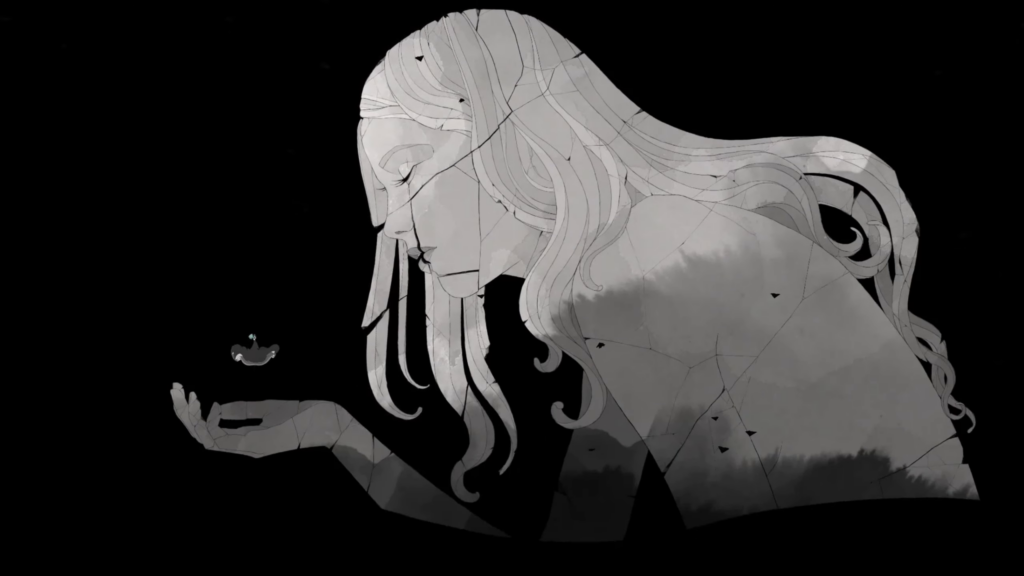
GRIS is an artistic 2D adventure-platforming game developed by a small “indie” team in Spain. It was praised for its beauty and emotional resonance and sold over a million copies. I heard about it because some of the videogame streamers I was following at the time (2018) decided to record playthroughs. The game has no combat or “fail-states” and is deliberately frustration-free.
The story is told almost entirely through visuals and symbolism, instead of dialogue or text. It takes the player on a metaphorical journey through the stages of grief, as the protagonist learns to accept separation from (or the death of) her Mother. She loses her voice at the beginning of the game and her world is totally gray. When she finally accepts her loss (during the above cutscene), she feels a sort of reconnection with her Mother, and color is restored to the world.
Artwork can sometimes illustrate meanings beyond those envisioned by the artist, and I see an alternative interpretation for the final cutscene. Many people in the Western world feel our cultures have become soulless and sterile (gray), and we feel a loss of connection to our ancestors (represented by the statue) – whom we are told deserve to be shamed and forgotten.
If we attempt to honor our forefathers – American or European – shame and disparaging epithets are often directed at us (black slime), and many people shrink or withdraw. Our ancestors sacrificed so much to build Western civilization and they worked to purposely pass on its rich institutions and traditions to us – their descendants. We must be willing to accept the denigrations and aspersions headed our way as we honor and love them – it is the only way to recover our heritage (return color to our world).

Comet Observatory 2 – Super Mario Galaxy
This is another one of those tracks that I can’t believe was composed for a videogame. It sounds like the type of waltz you might hear played at a wedding reception.
Can’t really blame nostalgia for my high opinion of this one – I never played the game! … Of course I’ve played Mario games before, but that was mostly the classic 2D games. I’ve missed most of the 3D platformer Nintendo games.
There are 3 total versions of this theme, with more components being added to the composition as the player progresses. I think the early version is too simple, the final version is too “busy,” and this one is just perfect.

This melancholic song is from another game I’ve never played. In the Dark Souls universe there is a natural cycle between ages of light and darkness. This theme is named after the tragic antagonist, Gwyn – who is an ancient king drawing his power from a mystical light-bringing flame.
His kingdom arose during an age of light and was once great, but has since been filled with corruption and overrun by demons. Instead of yielding to the inevitable age of darkness, Gwyn dedicates himself to preserving what is left of the now dying flame. His actions keep his ordered kingdom temporarily intact and avoids total chaos, but it also allows the demons to continue roaming free.
The game makes it clear that his decision comes at great personal sacrifice, but he chooses to fight the world’s natural cycle because he fears humanity’s limitless “Dark Soul” potential. It’s said during in-game dialogue that Gwyn “trembles at the Dark” and his theme song was specifically composed to be played only on the white piano keys (avoiding the sharp/flat dark keys).
Tracks with (Non-English) Vocals
English is a wonderful language, but hearing lyrics in an unfamiliar language can increase the emotional impact of a song. Game directors will sometimes use this to highlight character moments or capture important story elements.
Sid Meier’s Civilization series is widely considered one of the most fun “educational” games ever made. The game simulates building a civilization from the stone age to the modern era. Players learn about historical figures, inventions, economics, resource management and trading, as well as the dynamics of warfare and diplomacy.
Long term planning is essential at higher difficulty settings with some people opting to fill out spreadsheets (for fun!) in order to maximize their advantages over rival civilizations in the game. However, I choose to go the easier route and have fun by exploring different strategies for building toward the future.
The 4th version of the game is my favorite, with voice over lines provided my Leonard Nimoy (the actor that played Spock in Star Trek). This game also lets you build beyond the modern era into the “space age.” Christopher Tin composed this theme, and it became the first music from a videogame to win a Grammy award.
“Baba Yetu” is a translation of the Lord’s Prayer, sung in Swahili.

Metal Gear Solid is a stealth-action game with an engaging, complex story filled with espionage and betrayal. The protagonist is a highly intelligent super soldier, required to function as a (Rambo style) one-man-army in order to infiltrate a captured military island and eliminate a rogue element engaging in nuclear blackmail.
Story elements include: genetic cloning; a targeted bioweapon (retrovirus designed to induce heart attacks in a specific person); a bipedal walking tank armed with nuclear missile railguns; military-industrial “black projects”; government betrayal of its own soldiers; and hints of a shadowy global conspiracy group.
“The Best is Yet to Come” is sung in Irish Gaelic (Gaeilge – a living Celtic language). This language was deliberately chosen for its unfamiliar sound that would add emotional impact to the game’s climax. The song aims to be hopeful and consoling to a player character that has endured pain, loss, betrayal, and the destruction of his worldview – reassuring him that his sacrfice was worth it, and inviting him to embrace the possibility of feeling happiness again.

In the Ace Combat series, you pilot a fighter jet on military missions. The game takes place on a fiction Earth-like planet that has been ravaged by asteroid impacts. You start on the losing side of a war, but the player character gradually turns the tide until the enemy government surrenders.
After the enemy surrenders, rogue elements in their military activate a newly-completed super weapon (Megalith) to get revenge. The weapon redirects asteroid fragments to bombard chosen targets. This song is a modified version of Agnus Dei (Latin for Lamb of God) that plays during the final mission to destroy the new weapon.
Dragon Age: Origins is a dark fantasy RPG with a deep story that allows the player to make several branching choices throughout the game to influence the ending. You meet several characters along the way, some of them will join your party and aid in combat.
One of those characters is Leliana (commonly misspelled with two n’s – even in the official soundtrack). She has a violent past serving as a spy and assassin, but was betrayed and fled to a small village church seeking redemption as a Lay Sister. After joining you party to help fight evil, she sings the above song.
The song is performed in a fictional “elvish” language specifically created for this game. The language is more of a cipher, as it’s incomplete and fragmented – in contrast to the full elven language created for The Lord of the Rings.

Leave a Reply