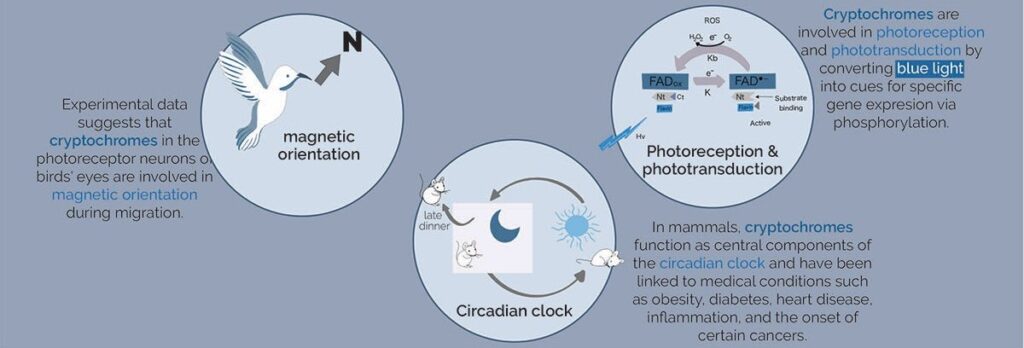
Cryptochrome (often shortened to CRY) is a special protein found in almost all living things — from plants and insects to humans. It plays a big role in controlling our daily sleep-wake cycle.
Simple Breakdown:
What does it do?
- It is part of your body’s internal “clock” (called the circadian rhythm). This clock runs on a roughly 24-hour schedule and tells your body when it’s time to feel sleepy or awake.
- Cryptochrome acts like a brake on certain genes. It helps turn off the “wake-up” signals at the right time so your body knows when to rest.
How it works:
- During the day, other proteins (CLOCK and BMAL1) turn on genes that make you feel active and awake. They also make more cryptochrome and similar proteins (called Period or PER).
- Cryptochrome and PER proteins build up slowly in the cell. Once there’s enough of them, they move into the cell’s control center (the nucleus) and say:
“Okay, that’s enough — turn those wake-up genes off now.” - This stops the cycle for a while. Then the levels of cryptochrome drop, the brake is released, and the cycle starts again the next day.
This back-and-forth creates the natural ~24-hour rhythm of sleep and wakefulness.
Its Role in Sleep:
- Timing of sleep: Cryptochrome helps your brain know “it’s nighttime, time to sleep.” People with mutations (changes) in the cryptochrome gene can have sleep disorders — like falling asleep extremely early or extremely late.
- How much and how deep you sleep: Studies on mice without cryptochrome show they sleep more and sleep more deeply. This suggests cryptochrome normally helps limit how much sleep you need and keeps sleep from becoming too long or too heavy. It balances both when you sleep and how strong your sleep drive is.
In short:
Cryptochrome is one of the key “clock proteins” that keeps your sleep schedule on track and helps control how sleepy you feel. Without it working properly, your sleep timing and sleep quality can get messed up.
…
In plants and insects, cryptochrome works like a built-in light detector for blue light (the kind that comes from the sun during the day or from phone/computer screens at night). Here’s how it works in simple terms:
The Light-Sensing Trick
- Cryptochrome has a special molecule inside it called FAD (flavin adenine dinucleotide). Think of FAD as a tiny light-sensitive switch.
- When blue light hits it, the FAD absorbs the energy from the light particle (a photon). This causes a quick chemical change — kind of like flipping a switch from “off” to “on.”
- Once activated, the cryptochrome protein changes shape slightly. This new shape lets it interact with other proteins in the cell.
What Happens Next in Plants
- The activated cryptochrome sends signals that tell the plant:
“It’s daytime!” - This triggers changes like:
- Growing shorter and stronger stems (instead of tall and spindly in the dark).
- Opening leaves to catch more sunlight.
- Helping decide when to make flowers.
- Plants use this to know the difference between day and night, and even the seasons.
What Happens in Insects (like Fruit Flies)
- Blue light activates cryptochrome, which then grabs and breaks down another clock protein called TIM.
- Destroying TIM resets the insect’s internal clock, helping it stay synced with the actual day-night cycle outside.
- Without cryptochrome, flies have trouble adjusting to new light schedules (like jet lag).
Why This Is Different in Humans
In humans and other mammals, cryptochrome lost most of its light-sensing superpower over evolution.
- Our version still has the FAD molecule, but it mostly works as a clock brake inside the cell (as explained before) without needing light to activate.
- We get our main light signals for sleep timing from special cells in our eyes that detect blue light through a different protein called melanopsin (not cryptochrome).
- However, some studies suggest human cryptochromes might still have very weak light sensitivity or other roles (like possibly helping with magnetic sense in birds, but that’s still being researched).
Takeaway:
That’s why staring at blue light from screens at night can mess up your sleep — it tricks your brain into thinking it’s still daytime, even though your cryptochrome isn’t the main sensor anymore. Plants and bugs rely heavily on cryptochrome as their “eyes” for blue light, which is why they’re super sensitive to it!

Leave a Reply