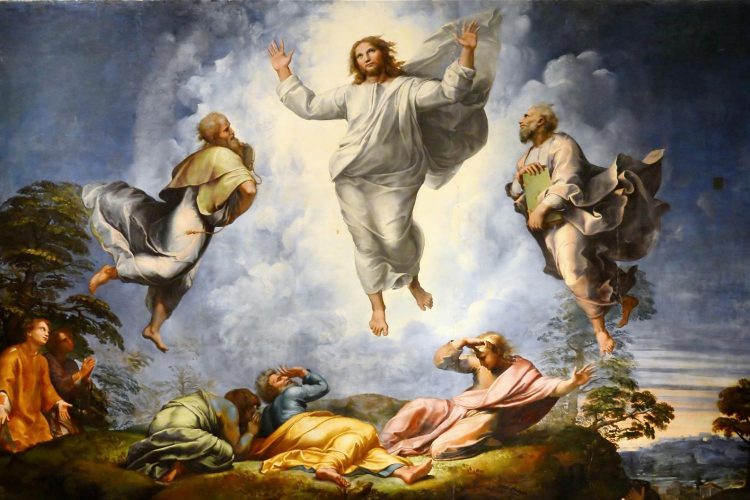
I see this icon as a depiction of Christ uniting two common archetypes: Tradition and Mysticism.
The Traditional approach to faith (symbolized by Moses) focuses on liturgy and often interprets what is written (the Bible) in a literal way. Moses is described by the Church Fathers as representing The Law.
The Mystical approach to faith (symbolized by Elijah) seeks to develop a personal relationship with God and searches for deeper meanings (abstract or allegorical) in what is written. Elijah is described by the Church Fathers as representing The Prophets.
While there can be tension between them, both of these archetypes actually work together through time. The Mystic uses Tradition as a foundation to generate new (or recover old) insights, and those insights will eventually be refined and incorporated into tradition going forward.
A similar dynamic plays out between the Greek philosophers Plato and Aristotle, as depicted in Raphael’s famous painting (The School of Athens). Plato is seen pointing to the Heavens (abstract metaphysical realm). Aristotle is shown with his palm facing the ground (observable empirical reality).
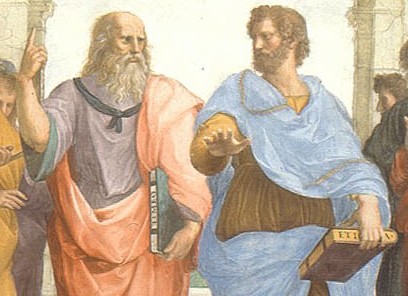
The modern secular world is fully absorbed in the physical view of reality. I don’t think modern Christianity has entirely escaped this influence, and has been sliding further into this view over the last several hundred years. With a background in biological sciences, I certainly have an appreciation for this view of the world.
Perhaps it’s just the contrarian in me, but I’ve found myself leaning much more heavily into the metaphysical interpretation of reality. I think that is much closer to how the early Christians saw things. I’ve been seeking out writings from the Church Fathers and focusing on the more symbolic writings of Mystics like Origen, Augustine, and Pseudo-Dionysius the Areopagite.
…
Below is a good discussion on the symbolism of the Transfiguration (followed by some notes).

Core Themes
- Transfiguration as the fulfillment of symbolism: Old Testament symbols, types, and partial revelations (e.g., Moses seeing God’s back, Elijah hearing the still small voice) point toward a direct encounter with God in Christ. Symbols act as a ladder or “throwing together” (from the Greek roots of symbol) to bring us into union with the divine, but in the Transfiguration, participants meet the reality itself—Christ as the source of revelation.
- The event (from the Gospels): Jesus takes Peter, James, and John up a mountain (traditionally Tabor). He is transfigured—his face shines, his garments become dazzling white—while Moses and Elijah appear conversing with him about his “exodus” (crucifixion). A bright cloud overshadows them, the Father’s voice speaks, and the disciples react in awe/fear.
Key Elements of the Transfiguration Icon
- Christ in the center, radiating divine light (often in a mandorla that blends dark-to-light tones, evoking “divine darkness”—the unknowable essence of God beyond created light).
- Moses and Elijah flanking him (representing the Law/Prophets, living and dead, or partial vs. full revelation).
- The three disciples below, often in chaotic poses (falling, turning away), sometimes losing a sandal (echoing holy ground/Moses at the burning bush, or shedding “garments of skin”/passions).
- Christ’s white garments shining, showing matter itself participating in uncreated glory.
Is there a connection between Moses/Elijah and the apostles present at the Transfiguration?
Moses (Law) ↔ Peter (Rock of the Church / Tradition)
This pairing has strong resonance:
- Moses is the giver of the Law and the foundational figure of the Old Covenant — the structured, authoritative tradition that guided Israel.
- Peter is the “rock” upon whom Christ builds His Church (Matthew 16:18), the keeper of the keys, and a stabilizing figure for apostolic authority and tradition in the New Covenant.
In the Transfiguration, Moses appears with Christ to show that the Law is fulfilled and upheld in Him, not abolished. Similarly, Peter (who impulsively wants to build tabernacles, echoing Old Testament feasts and structures) represents the Church’s role in preserving and handing on what has been revealed. The Church, founded on Peter, carries forward the apostolic tradition — much like Moses preserved and transmitted God’s Law.
The institutional/structural side of revelation (Law → Church Tradition) finds its center in Christ.
Elijah (Prophets) ↔ John (Mystical Apostle)
This also works beautifully:
- Elijah embodies the Prophets — fiery, visionary, mystical figures who hear God’s voice in dramatic (and sometimes subtle) ways, confront idolatry, and point forward to God’s action. Elijah’s encounter with the “still small voice” and his ascension highlight direct, experiential knowledge of God.
- John (the Beloved Disciple) is widely seen as the most mystical of the apostles. He wrote the Gospel that emphasizes divine light, love, and intimate union with Christ (“the Word was God”), the letters focused on love and abiding in God, and the Book of Revelation — full of apocalyptic visions, symbols, and heavenly encounters.
Elijah’s prophetic spirit (visionary, contemplative, pointing to the future) finds a New Testament echo in John’s theology of light, glory, and mystical union. On the mountain, Elijah converses with Christ about the “exodus” (Passion), and John later witnesses the ultimate glory at the Cross and in his visions.
This pairing highlights the contemplative/mystical dimension of revelation: Prophets → Mystics who experience God’s presence directly.
James: The “Normal” or Overwhelmed Believer?
(I’m less sure about this one)
- James (often shown falling backward, hands over his eyes, most dramatically overwhelmed) represents the ordinary faithful or the human response of awe, fear, and humility before divine glory.
- In traditional interpretations, the three apostles together symbolize the theological virtues:
- Peter — Faith (he confessed Christ as the Son of God).
- James — Hope (he was the first apostle martyred, enduring faithfully).
- John — Love (the disciple who remained at the Cross and emphasized divine love).
James’ overwhelmed posture in icons captures how most of us react to a direct encounter with God’s glory — falling back, shielding our eyes (the nous not yet fully purified), yet still invited to witness. He represents the “everyman” disciple: not the institutional rock (Peter) nor the mystic visionary (John), but the one who simply struggles in the presence of the holy.
Overall
- Old Testament foundations (Law + Prophets) → New Testament fulfillment in the Church (institutional/traditional + mystical/contemplative + ordinary faithful).
- All converging on Christ as the radiant center.
This isn’t a rigid “official” allegory found uniformly in the Fathers (who more often stress Law + Prophets broadly, or the three virtues), but it harmonizes well with how typology works in Scripture and icons — inviting personal and communal reflection.
The Transfiguration is a microcosm of the whole Christian life: grounded in tradition (Moses/Peter), open to mystical encounter (Elijah/John), and humbly received by ordinary believers (James).
…
Samuel: The Bridge and a Corrective Figure
Samuel is the clearest point of connection:
- He served as judge, priest, and prophet.
- He corrected the failures of the previous system (e.g., the corrupt priest Eli and his sons).
- When Samuel’s own sons proved corrupt as judges, the people demanded a king. Samuel (as prophet) warned them strongly against it (1 Samuel 8), anointing Saul reluctantly while continuing to call the nation back to covenant faithfulness.
- He later confronted King Saul (the new order) for disobedience—showing the prophetic role of holding leaders accountable.
In this sense, the prophetic voice did correct mistakes tied to the judges’ era: idolatry, weak leadership, and failure to uphold the Law fully.
The “Law/Judges” side represents structured authority and tradition (which can become rigid or corrupt), while the Prophets bring fresh, corrective, Spirit-led confrontation and vision. They are meant to work in harmony—Law provides the foundation, Prophets call people back to it when forgotten. In the Transfiguration, their peaceful unity around Christ shows the ultimate reconciliation of these dimensions in Him.
Theological Highlights
- Nous (noetic faculty/eye of the heart): A direct, pre-discursive way of knowing God, purified through spiritual practice (stillness, repentance) so one can encounter divine light/energy rather than just concepts.
- Divinization and matter: Christ’s transfigured humanity (and even his clothes) shows the goal of the spiritual life—creation (including inanimate matter) can bear God’s glory and be gathered back to Him in thanksgiving (Eucharistic vision). This contrasts with fallen tendencies to treat the world as dead or merely consumable.
- Anti-symbolism / end of symbolism: Once you have the reality (the incarnate Christ), symbols aren’t discarded but fulfilled and typologically continued. It’s like moving from a photo of someone to being with them in person.
- Tension of extremes: Glory on the mountain vs. the hidden glory of the Cross; beauty/celebration alongside self-emptying sacrifice.
Nous (Greek: pronounced “noos”) is a central concept in Eastern Orthodox Christian theology and spirituality, often translated as the “eye of the soul,” the “eye of the heart,” or the “noetic faculty.” It refers to the highest, intuitive, and spiritual faculty of the human person—the direct perceptive organ by which we can encounter and know God (and spiritual realities) immediately and experientially, rather than through concepts, logic, or reasoning.
Etymology and Classical Roots
The word nous comes from ancient Greek philosophy, where it broadly meant “mind,” “intellect,” or “understanding.” In Plato and Aristotle, it often denoted the faculty of intuitive insight or direct apprehension of truth (e.g., grasping first principles or essences), distinct from dianoia (discursive, step-by-step reasoning). Early Christian writers adapted and deepened this term, especially in the patristic tradition, giving it a distinctly spiritual and therapeutic emphasis.
In Eastern Orthodox Theology: The “Eye of the Heart”
Orthodox Fathers describe the nous as:
- The highest faculty of the soul (St. Gregory Palamas calls it this explicitly).
- The spiritual center of the human person, frequently identified with the “heart” (kardia) in Scripture and the Fathers—not the physical organ, but the innermost core of our being where true self-awareness and communion with God occur.
- The part of us created to receive the Holy Spirit and directly perceive God. As one source puts it: “The nous is the eye of your soul. It’s the spiritual organ God gave you to perceive Him directly.”
Humanity is made in the image of the Trinitarian God (Nous/Father, Logos/Word-Son, Spirit). Correspondingly, the soul reflects this: nous (intuitive spiritual perception), logos (reason/word), and spirit. Angels have intelligence and nous; humans uniquely have reason (logos and dianoia), nous, and sensory perception—making us a “microcosm” of creation.
Key Distinction: Nous vs. Dianoia (and Reason)
This is one of the most important clarifications:
- Dianoia (discursive intellect/reason): The analytical, logical, conceptual mind. It thinks in abstractions, builds arguments, processes information step-by-step, and is tied to the brain and senses. It is essential for daily life, theology as a science, and ordering experience—but it cannot know God directly. It knows about God.
- Nous: Pre-discursive, intuitive, receptive perception. It receives spiritual realities directly, like seeing light with the eyes rather than deducing it. It is where genuine gnosis (spiritual knowledge/experience) happens.
The Fathers sometimes repurposed the classical term nous (which could overlap with dianoia in philosophy or even St. Paul’s usage) to emphasize this noetic energy functioning in the heart. St. Paul contrasts nous with spirit in some passages, but patristic theology aligns the nous more closely with what Paul calls “spirit” when speaking of direct communion with God.
The Fall and the Darkened Nous
Before the Fall, Adam and Eve’s nous was pure, in constant communion with God (noetic memory of Him). After the Fall, the nous became darkened or “sick”:
- It was entangled with passions, senses, and the rational mind.
- Rebellion of reason (dianoia) against the nous contributed to this.
- Result: We lost direct perception of God; spiritual blindness set in. Most people today operate almost entirely with a darkened nous, mistaking rational thought or emotions for spiritual reality.
Orthodox spirituality views the Church as a “hospital for the soul.” The goal is therapy (healing) of the nous—not mere moral improvement or intellectual belief.
Purification, Illumination, and Theoria
The nous is healed and returned to the heart through:
- Ascetic practices (prayer, fasting, repentance, stillness/hesychia).
- Noetic prayer (especially the Jesus Prayer: “Lord Jesus Christ, have mercy on me”), which gathers the scattered nous back into the heart.
- Hesychasm (the tradition of inner quietude and unceasing prayer, defended by St. Gregory Palamas in the 14th century).
Stages of healing:
- Purification (catharsis): Cleansing from passions; nous begins to detach from distractions.
- Illumination (photismos): The nous is enlightened and begins to see God’s uncreated light (divine energies, not essence).
- Theoria (contemplation/vision): Direct, experiential knowledge of God. The purified nous beholds divine glory, feels uncreated love, and enters unceasing prayer of the heart.
This leads to theosis (deification)—the ultimate goal of the Christian life.
Connection to the Transfiguration
The nous is exactly what allowed Peter, James, and John to perceive Christ’s divine glory on Mount Tabor. They saw the uncreated light radiating from Christ—not with physical eyes alone, but with the purified nous (the “eye of the heart”). This light is the same divine energy Moses and Elijah encountered partially in the Old Testament, now fully revealed in the incarnate Christ. The event shows the nous‘s potential: matter itself (Christ’s body and garments) can participate in divine glory, and our healed nous can participate in that same reality. The disciples’ awe and fear reflect the overwhelming direct encounter that bypasses concepts.
St. Gregory Palamas used the Transfiguration as a key example in defending hesychasm: the light seen by the apostles is the same uncreated light contemplatable today by the purified nous.
Practical Implications
- Everyday life: Most of us live with a “darkened nous” tuned to the world (distractions, passions). Spiritual disciplines retune it toward God.
- Not anti-intellectual: Dianoia is good and necessary, but it must be rooted in a healthy nous.
- Modern relevance: This explains why Orthodox theology emphasizes experience of God over purely rational systems.
In short, the nous is the God-given capacity for direct, personal communion with the divine—restored in Christ so we can truly “know” Him as the apostles did on Tabor.

Leave a Reply