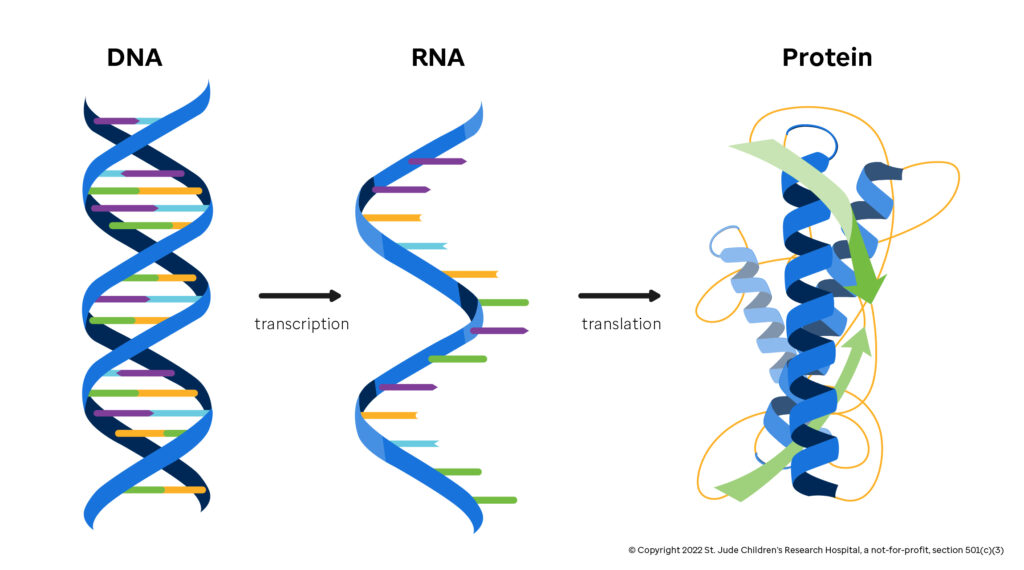
The central dogma of molecular biology describes the fundamental flow of genetic information in cells. Coined by Francis Crick in 1957–1958 and clarified in his 1970 Nature paper, it states that sequential information (the precise order of subunits) transfers from nucleic acids to proteins, but never in reverse from proteins back to nucleic acids or other proteins.
Crick’s original formulation emphasized what is impossible: once information enters a protein (as its amino acid sequence), it cannot flow back out to modify DNA or RNA. This unidirectional principle was key to understanding heredity and gene function post-DNA structure discovery.
The commonly taught simplified version is: DNA → RNA → protein.
- DNA replication: DNA makes a copy of itself (DNA → DNA), preserving genetic information for cell division and inheritance.
- Transcription: A gene’s DNA sequence is copied into messenger RNA (mRNA) by RNA polymerase (DNA → RNA). In eukaryotes, this occurs in the nucleus; the mRNA is processed (splicing, capping, polyadenylation) and exported to the cytoplasm.
- Translation: Ribosomes read the mRNA sequence in codons (triplets), recruiting transfer RNAs (tRNAs) to assemble amino acids into a polypeptide chain, forming a functional protein (RNA → protein).
This pathway explains how genes (DNA segments) encode proteins, the cell’s functional molecules. Some RNA viruses bypass DNA (RNA → protein or RNA → DNA via reverse transcription), but these are exceptions and do not violate Crick’s core rule against protein-to-nucleic-acid transfer.
Exceptions include:
- Reverse transcription (e.g., retroviruses like HIV, RNA → DNA).
- Prions (protein-based inheritance, protein → protein conformational change).
- Epigenetic modifications (not sequence information transfer).
Despite refinements, the central dogma remains a cornerstone: genetic information primarily flows from DNA to RNA to protein, guiding cellular function, development, and heredity.

Leave a Reply