.jpg)
What Are Fruit Flies?
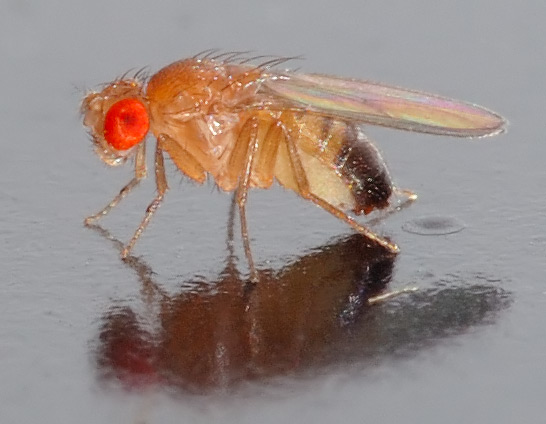
Fruit flies, specifically Drosophila melanogaster, are small flies commonly found near unripe or rotting fruit and fermenting materials. Their scientific name comes from the genus Drosophila (“dew lover”) and species melanogaster (“dark gut”). Despite the name, they are attracted to fermentation rather than fruit itself. They are tiny, easy to handle, and show sexual dimorphism: males are smaller with a darker, rounded abdomen and sex combs on their front legs, while females are larger.
Why Are They Used in Research?
Drosophila melanogaster has been a model organism in genetics and biology for over 100 years, starting with Thomas Hunt Morgan’s work on sex-linkage and genetic recombination. Key advantages include:
- Small size and low maintenance costs
- Short generation time (10-12 days at room temperature)
- Ease of anesthetizing and handling
- Many visible mutations available
- Ability to study Mendelian genetics, behavior, and development in a lab setting
Life Cycle
Fruit flies undergo complete metamorphosis with four stages: egg, larva (three instars), pupa, and adult. At room temperature (~22°C), the cycle takes about 10-12 days:
- Day 0: Eggs laid
- Day 1: Eggs hatch into larvae
- Days 2-7: Larval stages (feeding and growing)
- Day 7-11: Pupation
- Days 11-12: Adults emerge (eclosion)
Females can lay up to 100 eggs per day and become sexually mature 8-10 hours after emerging.
Genetics and Chromosomes
Fruit flies have 4 pairs of chromosomes. Mutations are well-documented, with notation like wild-type (+) and recessive/dominant alleles (e.g., white eyes as w). They are ideal for studying inheritance patterns, genotypes (genetic makeup), and phenotypes (observable traits).
Researchers estimate that approximately 60-70% of all human genes have identifiable orthologs in Drosophila. This figure rises to about 75% (and sometimes higher in specific datasets) for genes associated with human diseases.
This conservation is particularly strong for fundamental biological pathways, including those involved in development, cell signaling, neurodegeneration, cancer, and metabolism.
DAM system
The Drosophila Activity Monitoring (DAM) system (from TriKinetics) is the standard high-throughput tool for measuring locomotor activity—and thus sleep—in fruit flies (Drosophila melanogaster). Individual flies are housed in small glass tubes (one end with food, the other capped for airflow). Each tube passes through a monitor with an infrared beam across the midpoint. Every time a fly walks and breaks the beam, an activity count is recorded.
Sleep is defined as bouts of inactivity lasting ≥5 consecutive minutes (no beam breaks). This proxy correlates well with behavioral criteria like increased arousal threshold and homeostatic regulation.
Monitors (typically holding 32 flies each) are placed in controlled incubators for long-term recording (days/weeks) under light-dark cycles or constant conditions, enabling analysis of total sleep, bout duration, latency, and rebound after deprivation.

Leave a Reply