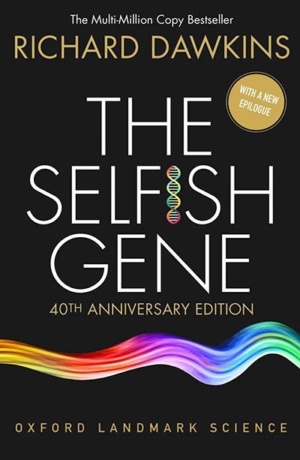
Chapter 1: Why Are People?
Dawkins introduces the biology of selfishness and altruism, arguing against group selection. Humans (and all organisms) are “survival machines” programmed by genes, which are expected to be ruthlessly selfish to survive in a competitive world.
Chapter 2: The Replicators
Explores the origin of life: Early self-replicating molecules (replicators) emerged in the primeval soup. Stable replicators that copied faithfully and built protective structures thrived, leading to the evolution of modern genes.
Chapter 3: Immortal Coils
Genes are potentially immortal as they pass unchanged through generations (except for rare mutations). Dawkins explains DNA structure, chromosomes, meiosis, and how genes survive in “gene pools” while individual bodies die.
Chapter 4: The Gene Machine
Organisms are “gene machines” or vehicles built by genes for protection and replication. Complex bodies evolved as cooperating gene colonies, with cells and brains allowing indirect gene influence on behavior.
Chapter 5: Aggression: Stability and the Selfish Machine
Uses game theory (e.g., Hawk-Dove strategies) to explain aggression and restraint. Evolutionarily stable strategies (ESS) emerge where selfish genes lead to balanced behaviors, avoiding costly endless fights.
Chapter 6: Genesmanship
Introduces kin selection and Hamilton’s rule: Altruism evolves when it helps relatives sharing genes (rB > C, where r is relatedness, B benefit, C cost). Explains apparent altruism as gene selfishness.
Chapter 7: Family Planning
Genes favor limiting family size to maximize survival chances per offspring. Parents invest resources optimally from a gene’s perspective, balancing quantity and quality of children.
Chapter 8: Battle of the Generations
Explores parent-offspring conflict: Offspring demand more resources than parents optimally provide, leading to weaning conflicts and sibling rivalry—all driven by differing genetic interests.
Chapter 9: Battle of the Sexes
Sexual reproduction and mate choice create conflicts between males and females. Strategies like coy females or promiscuous males arise from genes maximizing their own replication success.
Chapter 10: You Scratch My Back, I’ll Scratch Yours
Reciprocal altruism evolves in non-relatives via “tit-for-tat” strategies (e.g., Prisoner’s Dilemma). Cooperation pays when future interactions and cheater detection are possible.
The Prisoner’s Dilemma is one of the most famous thought experiments in game theory—a branch of mathematics that studies strategic decision-making. It shows why two rational people (or animals, companies, countries, etc.) might not cooperate, even when cooperation would make both better off.
The Classic Story
Imagine two criminals are arrested for a crime. The police don’t have enough evidence to convict them on the main charge, but they have enough for a lesser one. The police separate them and offer each the same deal:
- If both stay silent (cooperate with each other), they each get a light sentence: 1 year in prison.
- If one defects (accuses the other of the crime) while the other stays silent, the defector goes free (0 years), and the silent one gets a heavy sentence: 10 years.
- If both defect (accuse each other), they each get a medium sentence: 5 years.
Cooperation is best for the group (1 year each), but individual rationality leads to mutual betrayal and a worse outcome for both. No matter what the “other” person does, defecting gets you less jail time (1->0 years or 10->5 years). So if both are rational and selfish actors they will each defect and end up with 5 years in prison.
The Iterated Prisoner’s Dilemma
In real life, we often interact repeatedly. In the iterated version, cooperation can emerge because you can punish betrayal in future rounds. Strategies like Tit-for-Tat (“Cooperate first, then do whatever the other did last time”) often perform best—being nice, retaliatory, forgiving, and clear.
The simple “Tit-for-Tat” strategy won the first Iterated Prisoner’s Dilemma tournament, organized by professor Robert Axelrod at the University of Michigan in 1980.
Chapter 11: Memes: The New Replicators
Introduces “memes” as cultural units (ideas, tunes, fashions) that replicate via imitation, evolving independently like genes. Culture has its own Darwinian evolution.
Chapter 12: Nice Guys Finish First
Revisits cooperation using game theory: “Nice” strategies (e.g., forgiving tit-for-tat) can dominate in iterated Prisoner’s Dilemma, showing altruism as stable from selfish genes.
Chapter 13: The Long Reach of the Gene
Genes influence beyond the body – beaver dams or parasite manipulation of hosts. This is basically a preview of Dawkins’ later book The Extended Phenotype.

Leave a Reply