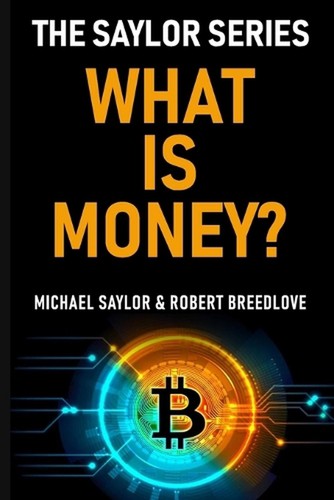
Robert Breedlove hosts a podcast that asks “What is Money?” It is highly critical of the modern Federal Reserve (Fiat) money printing system that constantly devalues the dollar and penalizes people that try to save. The podcast has a high opinion of Bitcoin and a generally positive view of Gold – as it was considered money historically. The following 5 properties answer the question, defining essential characteristics that money must possess:
Divisibility
Money must be divisible to accommodate exchanges of varying sizes. For example, it should allow for precise quantification of value in trades, from small daily transactions to large investments. Gold can be divided but not infinitely or without loss; Bitcoin’s satoshis (1/100,000,000th of a Bitcoin) enable perfect divisibility.
Durability
Money should resist physical degradation over time to preserve value. It needs to withstand wear, tear, or environmental factors. Precious metals like gold are durable but can still be lost or damaged; fiat paper money wears out. Bitcoin, as digital, is indestructible and immune to physical decay.
Recognizability
The authenticity of money must be easily verifiable by unbiased means, without relying on trusted third parties. This prevents counterfeiting and builds trust. Gold requires assays or experts; fiat relies on government backing. Bitcoin’s blockchain allows anyone to verify transactions transparently and instantly.
Portability
Money should be easy to transport across distances and borders without significant cost or risk. Physical gold is heavy and invites theft, limiting its use in a global economy; paper fiat improved this but still has borders. Bitcoin is “weightless” information, transferable globally at the speed of light for minimal fees.
Scarcity
The most critical property: money must have a supply that is inelastic (hard to increase) to maintain value against rising demand. If supply can be expanded easily, it leads to inflation (a “shadow tax” on savers). Gold’s scarcity comes from mining difficulty, but it’s not absolute; fiat has none, as governments print at will. Bitcoin’s hardcoded 21 million cap makes it the scarcest asset ever, akin to the unchangeable nature of time.
Interview with Michael Saylor
CEO of MicroStrategy (valued at over $50 Billion due to its holdings of over 650,000 Bitcoin)
The conversation begins with Saylor’s experiences in 2020, highlighting digital transformation’s acceleration. It delves into human evolution from vulnerable creatures to apex predators via primal technologies: fire, missiles (slings, arrows), and hydraulics (water power). Fire enabled warmth, cooking (evolving human anatomy for larger brains), hunting, communication, and metalworking, transitioning from Stone to Iron Age. Missiles allowed asymmetric hunting/warfare from safe distances, emphasizing terrain advantages. Hydraulics facilitated buoyancy for transport, dams for farming/fishing, and sanitation, fostering early civilizations like those in the Mediterranean. The Romans exemplify mastery: organized politics (annual elections tied to seasons), military (standardized weapons, no fair fights), and engineering (roads, aqueducts). Key theme: Survival through energy channeling and innovation; Bitcoin is likened to “fire in cyberspace.” Life expectancy rose to 72 under Romans but fell in later eras due to lost knowledge.
Key Insights:
Societies respecting natural law succeed.
Three primal technologies (fire, missiles, hydraulics) built everything.
All energy is solar; humans win unfair fights for efficiency.
Romans dominated via self-organization and protocols.
Engineer’s credo: Use intellect to improve the world.
This chapter covers civilizational regression post-Rome (life expectancy drops to 30) due to forgotten innovations like printing presses and wheels’ applications. The Renaissance revives progress via trade hubs (e.g., Venice as a canal-based distribution center). Empires centralize around networks (shipping, religion, taxation), with money as trust networks controlled by states for power. Reformation splits churches for economic/political reasons (e.g., Venice’s independent Catholic branch). Steel Age (19th-20th century) features robber barons like Rockefeller (Standard Oil as energy network/battery), Carnegie (steel for cities/bridges), and Mellon (aluminum for aviation). Food innovators (Kraft, Hershey, Post) stabilized energy via sanitation/branding, enabling national brands. Railroads and container ships revolutionized logistics. Antibiotics/sterilization boosted life expectancy to 70 by 1950, outpacing wars’ impact. Bitcoin offers secure, apolitical energy storage.
Key Insights:
Bitcoin: Best-branded asset (does exactly what it says); optimize for free exchange/experimentation.
Money is a trust network; states monopolize it for unlimited power.
Fixed costs collapse via standardization.
Empires export security; Bitcoin secures life force independently.
Food innovators stabilized energy; refrigerators/freezers suck entropy from food, like Bitcoin from money.
Saylor synthesizes themes: Humans advance by channeling energy (naval/air/nuclear/space power as “death from above”). Defensive attributes (indestructibility) trump offensive ones; antifragile systems absorb attacks (e.g., Romans copying tech). Bitcoin dominates as unbreakable, immortal money, adding features via extensions. Innovation often accidental/tinkering-driven (e.g., Wright brothers, Penicillin), not theoretical. War/generational shifts accelerate adoption. Tech fails until succeeding, appearing magical (Clark’s quote). Digital space empowers individuals, weakening geographic constraints; Bitcoin secures property without governments.
Key Insights:
Tinkerers, not theoreticians, drive breakthroughs.
Defensive > offensive; optimize for survivability.
Bitcoin dominates monetary networks via low-friction digital terrain and cryptography.
Digital space: Ultimate high ground; safeguards billions via seed phrases.
No need for states to honor money’s property rights—software does it.
Saylor introduces Bitcoin as the world’s first functioning digital monetary system, a “digital monetary energy network” that dematerializes value like tech giants (Apple, Google, Facebook) but for money. He compares it to phase transitions in physics, where monetary energy shifts from gold or fiat to Bitcoin, releasing productivity and profit. Money is described as the highest form of energy humans channel, evolving from chemical (fire) and gravitational (hydraulics) to electrical and now digital forms. Gold is critiqued as an inefficient energy network with high losses in transmission (e.g., 0.25% cost to move $100 million globally) and storage (2% annual inflation halves value in 35 years). Bitcoin solves this by enabling lossless, infinite-distance transmission and storage. Breedlove ties this to durability in money, noting gold’s scarcity reflects energy scarcity.
Key Insights:
Electrical grids lose 6% over 250 miles and can’t store power long-term; gold loses less but inflates 2% yearly; Bitcoin has zero loss.
Being a cynic about technology is a losing trade; humans innovate.
Bitcoin collapses monetary energy into a lower state, releasing value like exothermic reactions.
Humans prosper by channeling energy; Bitcoin is the most efficient network for storing and transmitting it across time, space, and domains.
Saylor explores how money represents human energy utilization, with Bitcoin as its ultimate form. He discusses historical energy mastery (fire, hydraulics, electricity) and how Bitcoin dematerializes money for global, instantaneous transfer. Inflation is likened to energy bleed in batteries (24% annual loss), while Bitcoin’s fixed supply prevents this. Breedlove highlights Bitcoin’s reach into chaos (via mining) to forge order, aligning with life’s anti-entropic nature. The chapter critiques fiat’s toxicity and gold’s limitations, positioning Bitcoin as “alive” monetary energy.
Key Insights (inferred from context and series pattern):
Nature isn’t fair; humans channel energy through intellect to create fairness.
Money is the highest form of energy that human beings can channel.
Bitcoin is digital gold, but superior in durability, portability, and divisibility.
The world is accelerating into a digital age where Bitcoin enables profound order from chaos.
Saylor examines energy mastery through history, from fire (chemical) to Bitcoin (digital). He argues Bitcoin is the pinnacle, allowing energy storage without loss. Examples include aqueducts channeling gravity and batteries’ inefficiency. Bitcoin’s network effect crystallizes value like steam to ice. Breedlove connects this to human evolution, noting fire’s role in digestion and brain growth. The chapter emphasizes Bitcoin’s resistance to entropy.
Key Insights (inferred):
Cooked food metabolizes 10x more efficiently, enabling larger brains.
Fire is a chain reaction releasing latent energy in matter.
Humans prosper by channeling energy smarter, faster, stronger.
Bitcoin masters monetary energy, outpacing gold and fiat.
The discussion shifts to dematerialization, where products/services collapse into digital forms (e.g., Library of Alexandria in your hand via Google). Bitcoin dematerializes money, enabling instant global transfers for pennies. Saylor contrasts gold’s physical constraints with Bitcoin’s infinite scalability. Breedlove notes Bitcoin’s role in immortal sovereignty, beyond physical limits.
Key Insights (inferred):
Bitcoin as low-frequency settlement, high-frequency store of value.
Digital networks dematerialize value, releasing energy (profits, cash flow).
Bitcoin is the first digital monetary network, collapsing into efficiency.
No restrictions on high-frequency transactions; keep 1-3% in fiat for small ones.
Saylor argues Bitcoin enables “immortal sovereignty” by engineering monetary systems antifragile to entropy. He critiques Bitcoin as a medium of exchange (dysfunctional for small transactions) but praises it as a store of value. Breedlove links Bitcoin to life’s anti-entropic principle, converting chaos to order. The chapter discusses crypto vs. digital networks, emphasizing Bitcoin’s role in extracting order from chaos. Saylor warns against over-focusing on medium of exchange, advocating layered systems (fiat for small tx, Bitcoin for settlement).
Key Insights:
All crypto enthusiasts should accept Bitcoin’s success as the gateway for alt-asset holders into crypto, encouraging $3 trillion inflow instead of internal sabotage.
The only market-proven crypto network is non-state digital store of value: Bitcoin.
The ability to do a minor transaction is trivially inconsequential. Only 1-2% of wealth needs high-frequency transactions; keep 1-3% in fiat.
Bitcoin doesn’t make sense as a medium of exchange now, and maybe never. It’s a low-frequency settlement network.
Saylor views Bitcoin’s creation as akin to discovering fire or atomic energy, sterilizing “toxic” fiat money infected with entropy. Inflation is misrepresented (CPI ignores assets, food, energy), leading to negative real yields (-10%). Breedlove ties this to Darwinian equilibrium disrupted by central banking. Stoicism is emphasized for navigating entropy, with warnings against over-acquisition (law of decimation: 10% of complex systems break yearly). The chapter critiques fiat’s defects and Bitcoin’s superiority.
Key Insights:
Actions matter over words; skin in the game vs. beliefs.
Fiat currency is toxic money, infected with entropy, affecting everything it touches.
The destiny of all money is encryption as a sterilization process for money’s rules and supply.
The creation of Bitcoin is an elemental force akin to discovering fire or atomic energy.
Most people budget for acquisition but underestimate maintenance due to lack of humility.
Inflation reallocates wealth via theft; Keynesian economics is an academic cover.
Unless growing cash flows >10% yearly, you’re diluted (hurdle rate).
Stoicism aligns with thermodynamics, entropy, complexity theory.
Live greatly, but one decision can define legacy (e.g., Marcus Aurelius).
Saylor and Breedlove discuss money as tokenized energy in socio-political contexts, critiquing gold’s historical failure and positioning Bitcoin as its digital successor—a paradigm shift from political to scientific money. Gold is debunked as a mythically perfect standard, dying through debasements, wars, and inefficiency in a globalizing world. Energy analogies highlight gold’s losses vs. Bitcoin’s efficiency.
Key Insights:
Shift to fiat solved some issues but created worse (inflation); Bitcoin resolves both.
Money is subjective tokenized energy; ideal money is a shared, immutable, correct ledger—Bitcoin approximates this.
Gold invites violence/confiscation; not truly scarce (inflates via mining/seizures); poor portability, verifiability, and velocity.
Historical gold standards were illusions—always relied on credits/ledgers; led to empire collapses (e.g., Rome).
Bitcoin channels monetary energy losslessly, outperforming gold (e.g., 10-year CAGR: Bitcoin 132% vs. gold 0.94%).
In this chapter, Michael Saylor explains why fiat currency outperforms gold in a globalizing, digitizing world by being “stronger, faster, and smarter”—enabling rapid credit creation, portability without physical weight, and reduced risk of theft or violence (e.g., via letters of credit, traveler’s checks, or credit cards). However, fiat fails due to inherent flaws: high inflation (7–11% annually on average, with spikes to 30–40%), which dilutes value like a leaking system, and confiscation risks from governments or counterparties. This makes fiat unreliable as a base-layer money, akin to building on sinking swampland, leading to weak property rights and economic instability.
Saylor highlights fiat’s advantages in enabling sophisticated economic applications, such as checks, derivatives, and high-velocity transactions that gold cannot match. It supports complex systems like banking networks, insurance, and global trade, fostering productivity and innovation (e.g., fractional reserve banking amplifies money supply for growth). However, these successes come with trade-offs: over-expansion leads to imbalances, asset bubbles, and moral hazards, as seen in historical examples like the U.S. dollar’s dominance post-WWII. Fiat’s flexibility drives short-term booms but sows seeds for long-term failures through dilution and centralization.
The discussion frames money as conserved energy or a “battery” for human effort, emphasizing scarcity, verifiability, and transferability as core ideas. Saylor argues that ideal money must resist inflation and censorship while channeling energy efficiently. Bitcoin emerges as the pinnacle, solving fiat’s issues by being digital, scarce (21 million cap), and decentralized. Historical analogies (e.g., gold’s limitations in speed) illustrate how money evolves to match societal needs, with Bitcoin representing a paradigm shift toward incorruptible, sovereign property.
This chapter traces money’s progression from primitive barter and shells to gold (durable but slow), fiat (fast but inflatable), and finally Bitcoin as digital monetary energy. Saylor uses metaphors like phase transitions (ice to water to steam) to describe leaps in efficiency. Gold enabled empires but faltered in digital eras; fiat powered industrialization but invited manipulation. Bitcoin evolves money into a global, instantaneous network, free from intermediaries, marking humanity’s ascent to channeling energy at light speed without loss.
Saylor evaluates money against classic properties: durability (Bitcoin’s immortality vs. fiat’s decay), portability (instant global transfer), divisibility (satoshis enable micro-transactions), verifiability (blockchain transparency), scarcity (fixed supply), and acceptability (growing adoption). Fiat scores well on convenience but poorly on scarcity and durability due to printing. Bitcoin excels in all, acting as “perfect money” that preserves value indefinitely, resists seizure, and empowers individuals over states, drawing parallels to energy storage in batteries or dams.
Bitcoin is positioned as superior digital property—immutable, borderless, and self-sovereign—contrasting with physical assets vulnerable to theft or devaluation. Saylor discusses how it grants true ownership without counterparty risk, enabling “cyber sovereignty.” Examples include protecting wealth from inflation or confiscation (e.g., in hyperinflating economies). The chapter emphasizes Bitcoin’s role in redefining property rights, turning abstract energy into tangible, indestructible wealth that aligns with natural laws of conservation.
The final chapter portrays Bitcoin as the ultimate monetary network, leveraging Metcalfe’s Law for exponential value through adoption. It’s a decentralized, energy-backed system that integrates with global infrastructure, outpacing fiat networks in security and efficiency. Saylor predicts mass adoption as institutions recognize its superiority, leading to a “Bitcoin standard” where it becomes the base layer for all finance. Analogies to the internet’s growth underscore Bitcoin’s potential to democratize energy and power, fostering a prosperous, uncensorable future.

Leave a Reply